
ISO 9001:2026 Changes: Key Updates & New Requirements

ISO/FDIS 9001 has been approved. ISO lists Edition 6 as under publication, and ISO/TC 176/SC 2 has announced 16 September 2026 as the scheduled publication date. Until the final standard is published, references below should be treated as a practical summary of the approved FDIS direction and public revision guidance, not a substitute for the published standard.
ISO 9001 is changing — but this is not a complete rebuild
ISO 9001 is approaching its sixth edition. For organisations already operating a mature ISO 9001:2015 quality management system, the important message is that the 2026 revision is expected to be a moderate update rather than a fundamental redesign.
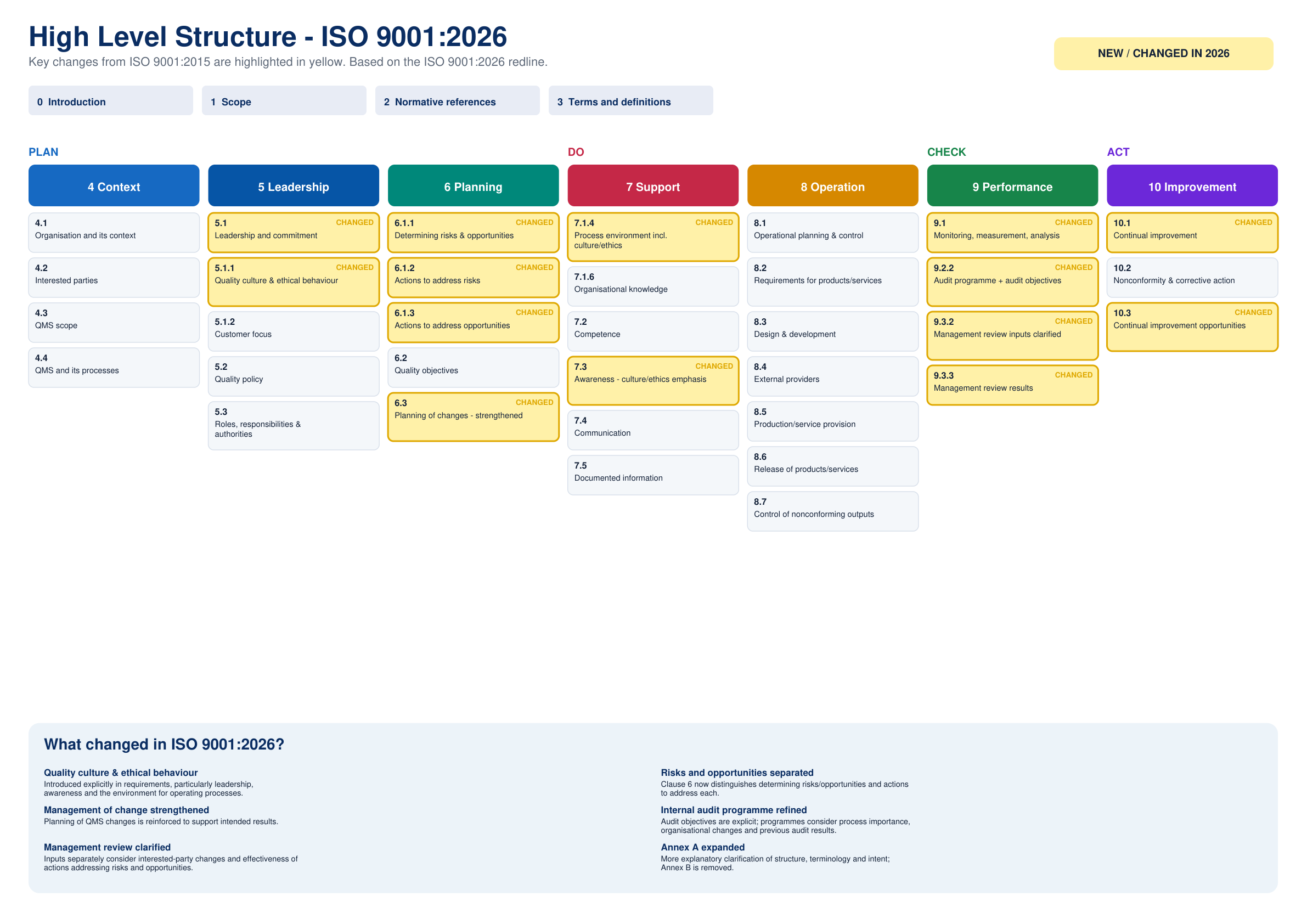
The familiar management-system framework remains. The process approach, risk-based thinking, the Plan-Do-Check-Act cycle and the core intent of a quality management system continue to underpin the standard. The revision instead sharpens several areas that have become increasingly important in modern organisations: quality culture, ethical behaviour, risks and opportunities, management of change, climate-related context, organisational knowledge and continual improvement.
This article explains the main changes clause by clause and highlights where organisations and auditors are likely to need the most attention during transition.
At a glance: where are the biggest changes?
The heat map below is an LMS TRG editorial assessment of relative transition impact. It is not an official ISO rating. Red indicates areas expected to require the greatest review; green indicates little or no substantive change.
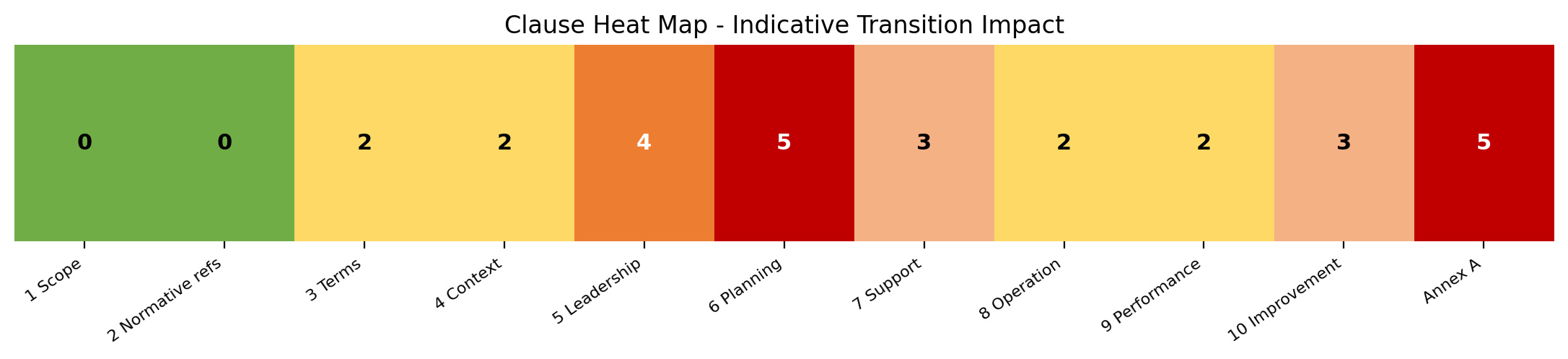
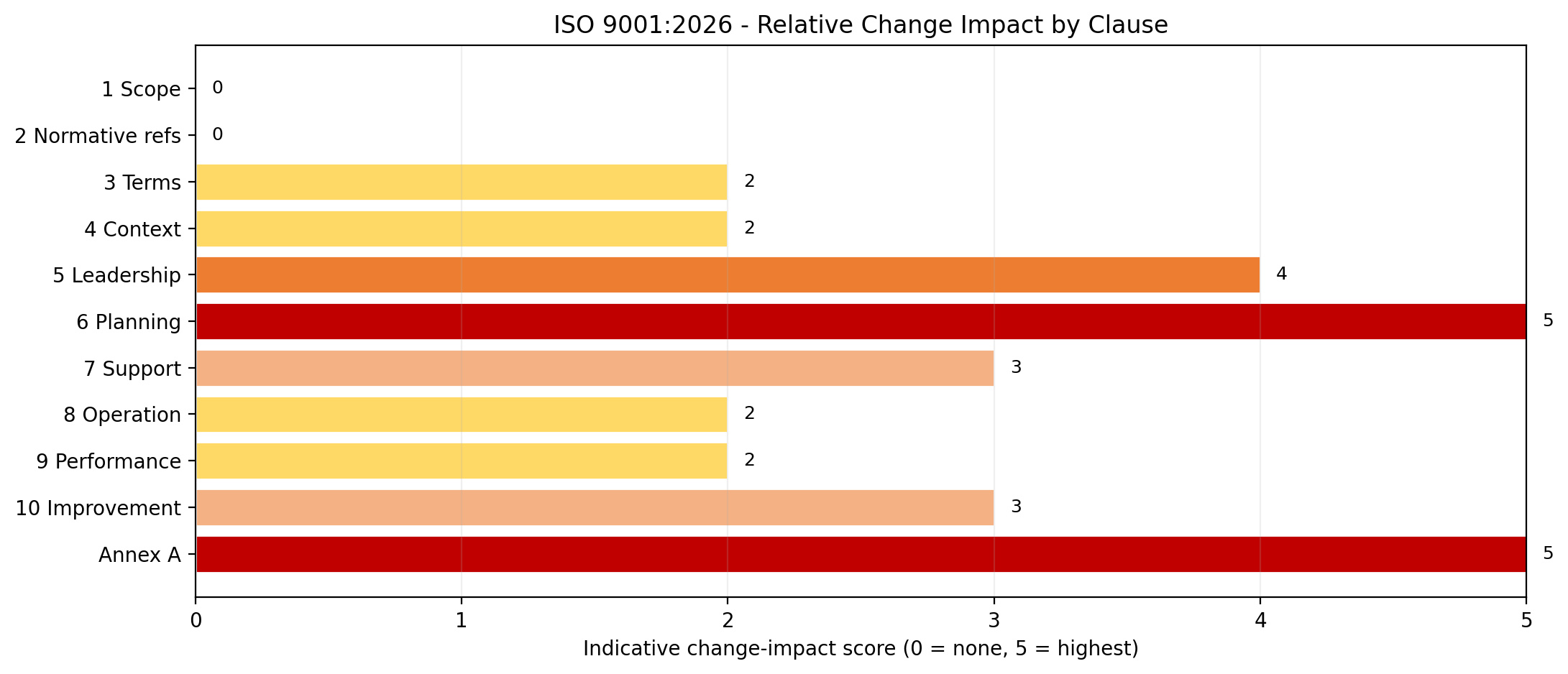
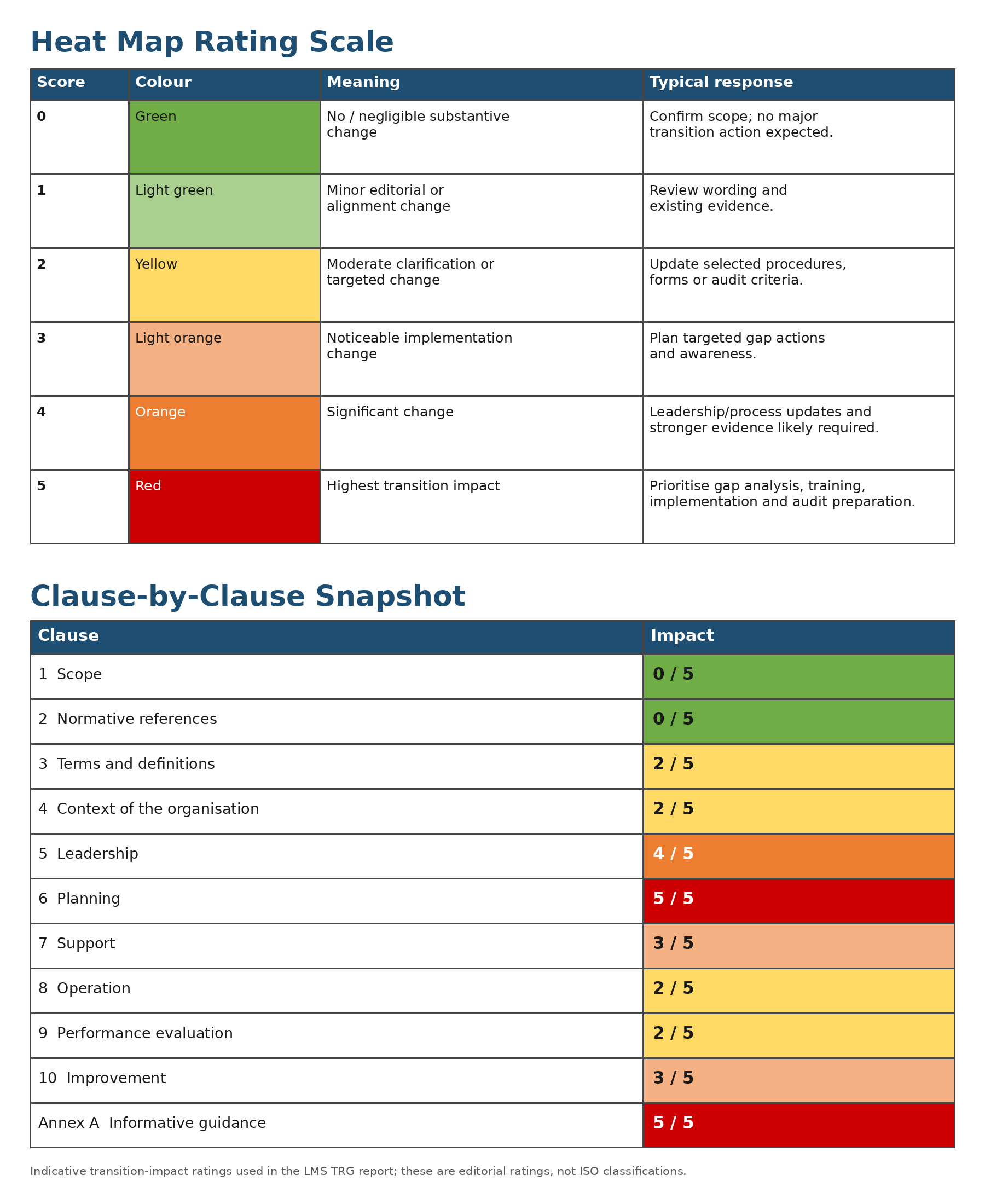
The strongest practical attention is expected around Clause 5 (Leadership) and Clause 6 (Planning). Annex A is also significantly expanded as guidance, although Annex A remains informative rather than a separate set of auditable requirements.
Clauses 1 and 2 — Scope and normative references
Indicative impact: Low / no substantive change
No major implementation change is expected in these opening clauses. The purpose of ISO 9001 remains centred on a quality management system that enables an organisation to consistently provide products and services that meet applicable requirements and enhance customer satisfaction. For most organisations, transition work in these clauses should be limited. The practical focus will remain on understanding the scope and applying the requirements appropriately to the organisation.
What organisations should do
For transition planning, confirm that the QMS scope is still accurate and reflects the organisation’s activities, products and services. Do not create transition actions merely to demonstrate activity where the requirement has not materially changed.
Clause 3 — Terms and definitions
Indicative impact: Moderate
The revised edition brings clarification and improved accessibility around terminology. This matters because consistent terminology supports more consistent interpretation of requirements across organisations, auditors and certification bodies. For users, the practical impact is less about creating new documents and more about checking that existing QMS language, training material and audit terminology remain aligned with the revised standard.
What organisations should do
For transition planning, review QMS manuals, procedures, training slides and audit tools for outdated terminology. Update internal auditor and employee awareness material where revised terminology changes interpretation.
Clause 4 — Context of the organisation
Indicative impact: Moderate
The climate-change amendments introduced to ISO management system standards in 2024 are integrated into the revised ISO 9001. Organisations need to consider whether climate change is a relevant issue within their context, while relevant interested-party requirements may also include climate-related requirements. This does not mean every ISO 9001 organisation needs an environmental management programme. The question is whether climate change can affect the organisation’s ability to achieve the intended results of its QMS, meet customer or regulatory requirements, maintain supply, deliver services or manage other relevant quality-related issues. Other amendments and clarifications within Clauses 4 to 10 are intended to improve application without fundamentally changing the established context framework.
What organisations should do
For transition planning, revisit the internal/external issues analysis and record the determination of climate-change relevance. Review interested parties and their relevant requirements. Check whether strategic, supply-chain, infrastructure or customer-related changes affect the QMS scope or processes.
Clause 5 — Leadership
Indicative impact: Significant
One of the clearest themes in the 2026 revision is a stronger emphasis on leadership responsibility for promoting quality culture and ethical behaviour. This moves the discussion beyond simply having a quality policy. Top management should be able to demonstrate how leadership behaviour, priorities, decisions and communication support a culture in which quality is understood and valued. For auditors, this may increase the importance of interviewing leadership and personnel to understand whether quality expectations and ethical behaviours are visible in day-to-day decisions, rather than relying only on documented statements.
What organisations should do
For transition planning, discuss quality culture and ethical behaviour at leadership and management-review level. Consider how leaders communicate expectations and reinforce appropriate behaviours. Ensure responsibilities and decision-making practices do not undermine product/service conformity or customer focus. Prepare internal auditors to seek evidence of culture through behaviour, communication and implementation rather than a single document.
Clause 6 — Planning
Indicative impact: Highest change impact
Clause 6 is likely to require the greatest transition attention. The revised direction makes the treatment of risks and opportunities clearer, including a clearer separation between determining risks and determining opportunities. This is important because many ISO 9001:2015 systems became heavily focused on risk registers while opportunities were treated as an afterthought. The revision reinforces that opportunities deserve deliberate consideration rather than being viewed only as the absence of risk. Management of change is also reinforced. Changes to the QMS should be planned and managed in a way that supports achievement of intended results. This is especially relevant where organisations introduce new technology, restructure operations, change suppliers, alter processes, implement new software or modify products and services.
What organisations should do
For transition planning, review the method used to identify and address both risks and opportunities. Check that opportunities are actively considered and not merely embedded in a risk score. Strengthen change-planning controls where necessary. For significant changes, consider purpose, consequences, QMS integrity, resources, responsibilities, implementation, monitoring and review.
Clause 7 — Support
Indicative impact: Moderate
Clause 7 is affected by the broader revision themes, particularly quality culture, ethical behaviour, awareness and organisational knowledge. The practical message is that people need more than procedural instructions. They need appropriate competence, awareness, information and knowledge to contribute to the effectiveness of the QMS. Organisational knowledge also remains important where critical know-how could be lost through turnover, restructuring, outsourcing or technology changes. Quality culture and ethical behaviour also connect to the environment in which people work and to awareness expectations.
What organisations should do
For transition planning, review competence and awareness content for the revised themes. Identify critical organisational knowledge and how it is maintained, shared and made available. Consider succession, lessons learned, technical knowledge, customer knowledge and process know-how. Update induction and refresher training where appropriate.
Clause 8 — Operation
Indicative impact: Minor / targeted amendments
The operational framework remains familiar. Public revision guidance indicates targeted amendments and clarifications rather than a major restructuring of Clause 8. Organisations should therefore avoid rewriting operational procedures simply because a new edition is being published. The better approach is to map the final wording against existing operational controls and change only what is necessary. Particular attention should be given to whether changes elsewhere in the QMS — for example risks, change management, knowledge or external-provider issues — flow through into operational controls.
What organisations should do
For transition planning, perform a gap review of operational procedures after the final text is available. Check that supplier/external-provider controls remain appropriate. Confirm that operational changes are linked to the organisation’s revised risk, opportunity and change-management processes.
Clause 9 — Performance evaluation
Indicative impact: Moderate
Performance evaluation remains central to determining whether the QMS is working. The revision includes targeted clarification within Clauses 4 to 10, and organisations should review internal audit and management review arrangements against the final published wording. For internal auditing, the important principle is that an audit programme should be purposeful and risk-informed, not simply a calendar of departments. Audit priorities, objectives, previous results, changes and process importance should inform the programme. Management review should continue to provide leadership with a meaningful evaluation of QMS suitability, adequacy, effectiveness and opportunities for improvement.
What organisations should do
For transition planning, review internal audit programme objectives, priorities and coverage. Update audit checklists to reflect the 2026 requirements. Review management-review agendas and inputs once the final standard is published. Ensure performance information leads to decisions and actions rather than being reported without evaluation.
Clause 10 — Improvement
Indicative impact: Moderate
Continual improvement is reorganised and clarified. Public revision guidance describes the new Clause 10.1 as largely consolidating requirements that sat in Clauses 10.1 and 10.3 of the 2015 edition. Expanded Annex A guidance also recognises that improvement may arise from changes in context, risks and opportunities, and adoption of technologies. Developments such as increased reliance on data and integration of technology can influence the nature and extent of improvement. The practical emphasis remains on using evidence from performance, nonconformities, audits, customer feedback, data and changing circumstances to improve the suitability, adequacy and effectiveness of the QMS.
What organisations should do
For transition planning, review how improvement opportunities are identified, prioritised and tracked. Connect improvement activity to performance data, risks, opportunities and changes in context. Consider how digitalisation, data and technology can improve processes without creating uncontrolled change.
Annex A — Expanded guidance
Indicative impact: Major expansion in guidance
Annex A is expected to be significantly expanded to provide clearer guidance aligned with Clauses 4 to 10. This is particularly useful for organisations, trainers and auditors seeking to understand the intent behind requirements. Annex A is informative. It should help interpretation, but it should not be treated as an additional list of auditable requirements. For training providers and auditors, the expanded guidance is important because it can support more consistent explanations of the standard and reduce overly narrow interpretations.
What organisations should do
For transition planning, use Annex A to support understanding of intent after publication. Do not raise nonconformities solely against informative guidance. Update auditor training and transition material to distinguish requirements from guidance.
What does ISO 9001:2026 mean for certified organisations?
ISO confirms that organisations certified to ISO 9001:2015 will be given a transition period to migrate to the new edition. Detailed transition rules and certification arrangements should be checked once the final standard and applicable accreditation guidance are issued. Because the changes are expected to be moderate, most organisations should be able to transition by reviewing their existing system rather than rebuilding it. The key is to identify genuine gaps, update affected processes and documented information, train relevant personnel and verify implementation through internal audit and management review.
A practical transition approach
A practical ISO 9001:2026 transition should begin by obtain and review the final ISO 9001:2026 standard when published. From there, Complete a clause-by-clause gap analysis against the existing QMS. Prioritise Clauses 5 and 6, then review the moderate-impact areas in Clauses 4, 7, 9 and 10. Update affected procedures, registers, audit tools, management-review inputs and training material. Provide transition awareness to top management, process owners and internal auditors. Implement the revised arrangements and retain appropriate evidence. Conduct an internal audit against ISO 9001:2026. Complete management review and close identified transition gaps before the applicable certification deadline.
What should auditors pay particular attention to?
For auditors, the revision is less about searching for new documents and more about evaluating whether the revised intent is genuinely embedded in the management system. Key areas of focus are likely to include:
For transition planning, how leadership promotes quality culture and ethical behaviour in practice. Whether risks and opportunities are both deliberately determined and addressed. Whether significant QMS changes are planned and controlled. How the organisation determined whether climate change is relevant to its QMS context. Whether organisational knowledge is maintained and available where needed. Whether audit programmes and management review remain effective and aligned with the revised requirements. Whether improvement is driven by evidence, changing context, risks, opportunities and appropriate use of technology.
ISO 9001:2026 transition training and auditor development
Successful transition is not only a document-update exercise. Quality managers, process owners and auditors need to understand why the requirements have changed and how the revised intent should be applied in practice. ISO 9001:2026 transition training can help organisations prepare their gap analysis, update internal audit criteria, review management-system processes and build awareness before certification transition activities begin. For auditors, updated ISO 9001 internal auditor training and ISO 9001 lead auditor training are particularly important because audit evidence and interview techniques need to reflect the revised expectations around leadership, quality culture, risks and opportunities, change management, organisational knowledge and continual improvement.
About LMS TRG
LMS TRG provides 100% online and self-paced ISO management systems and auditor training for professionals who want practical, flexible learning. Our training covers ISO 9001 Quality Management Systems from foundation through to internal auditor and lead auditor level, together with training across other key management system standards. As ISO 9001 moves to the 2026 edition, LMS TRG is updating its ISO 9001 transition training and auditor learning material to help organisations and auditors understand the new requirements, prepare for transition and apply the revised standard in practice.
Explore LMS TRG training and resources at www.lmstrg.com.
Important note
This article is educational guidance and does not reproduce or replace ISO 9001. At the time of writing (30 August 2026), ISO lists the sixth edition as under publication. ISO/TC 176/SC 2 announced that ISO/FDIS 9001 was approved and that publication is scheduled for 16 September 2026. Organisations should verify requirements against the final published standard and applicable certification/accreditation transition rules.
Join The Community
Our email content is full of value, void of hype, tailored to your interests whenever possible, never pushy, and always free.