
7 Invalid Audit Nonconformity Examples | ISO Audit Findings
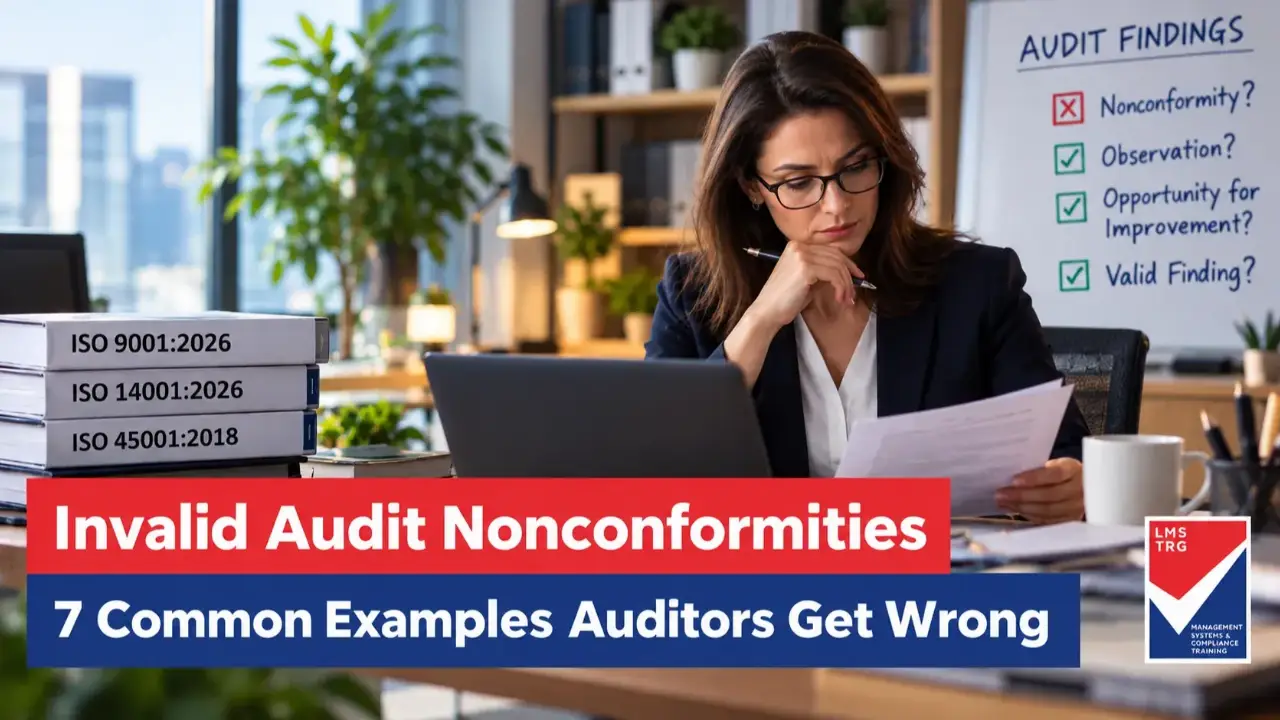
Invalid Audit Nonconformities: 7 Common Mistakes Auditors Must Avoid
Not every audit observation is a nonconformity. Learn how to identify invalid audit findings, evaluate objective evidence and write nonconformities that stand up to scrutiny.
An audit nonconformity (NC) can have significant consequences for an organisation, from additional corrective actions and resources to potential certification issues.
But what happens when an auditor raises a nonconformity that isn't justified?
Poorly written or invalid audit findings can create unnecessary work, damage confidence in the audit process and distract organisations from genuine opportunities for improvement.
Whether you're conducting an ISO 9001, ISO 14001 or ISO 45001 audit, understanding the difference between a valid nonconformity, an observation and an opportunity for improvement (OFI) is an essential auditing skill.
What Makes an Audit Nonconformity Valid?
A nonconformity is the non-fulfilment of a requirement.
For an audit nonconformity to be justified, the auditor must establish three essential elements:
-
A specific audit requirement: Identify the applicable ISO clause, legal obligation, contractual requirement or organisational procedure.
-
Objective audit evidence: Present verifiable facts demonstrating what was observed, reviewed or confirmed.
-
A clear failure to meet the requirement: Explain precisely how the evidence demonstrates non-fulfilment.
If an auditor cannot establish these elements, the finding may be unsupported, incorrectly classified or invalid.
Remember: An auditor's opinion is not an audit requirement.
7 Examples of Invalid Audit Nonconformities
1. Raising an NC Based on Personal Preference
Invalid NC: "The organisation does not use a risk register in Excel."
Why is it invalid?
ISO management system standards generally do not prescribe a particular software application or format for maintaining risk information.
If an organisation effectively manages its risks using another method that meets the applicable requirements, the auditor cannot demand an Excel spreadsheet simply because they prefer it.
Auditor's lesson: Audit against requirements, not your preferred way of working.
2. Raising an NC Without Objective Evidence
Invalid NC: "The organisation's training process is ineffective."
Why is it invalid?
This statement is a conclusion without supporting evidence.
What specifically was ineffective? Which requirement was not met? What records, interviews or activities support the finding?
A valid finding must identify the actual failure and provide sufficient objective evidence.
Auditor's lesson: If you cannot explain what failed and demonstrate it through verifiable evidence, investigate further before raising an NC.
3. Raising an NC Because Documentation Looks Different
Invalid NC: "The organisation does not have a separate Quality Manual."
Why is it invalid?
ISO 9001:2026 does not require organisations to maintain a document specifically titled "Quality Manual".
An organisation may meet its documented information requirements through processes, procedures, electronic systems or other suitable methods.
Auditor's lesson: Understand the difference between mandatory documented information and optional documentation.
4. Raising an NC Against the Wrong ISO Clause
Invalid NC: "Employees were not wearing safety glasses. Nonconformity against ISO 9001 Clause 7.2 – Competence."
Why is it invalid?
The observed failure may represent a genuine occupational health and safety issue, but the cited quality management clause does not automatically establish the relevant requirement.
The auditor must identify the applicable audit criterion, such as a workplace safety procedure, legal obligation or relevant ISO 45001 requirement.
Auditor's lesson: A genuine problem can still result in a poorly justified finding if the wrong requirement is cited.
5. Treating an Opportunity for Improvement as an NC
Invalid NC: "The organisation should introduce monthly management meetings instead of quarterly meetings."
Why is it invalid?
Unless a specific applicable requirement establishes that frequency, the auditor cannot classify a different meeting schedule as nonconformity merely because monthly meetings might be beneficial.
This may be an opportunity for improvement, provided the suggestion is appropriate and does not compromise auditor impartiality.
Auditor's lesson: Don't turn recommendations into mandatory requirements.
6. Raising an NC Based on Assumptions
Invalid NC: "The organisation probably does not review its environmental objectives regularly."
Why is it invalid?
Words such as "probably", "appears" and "seems" may indicate that the auditor has not gathered sufficient evidence.
The auditor should verify the relevant requirements and examine available records, interviews and other evidence before reaching a conclusion.
Auditor's lesson: Audit findings must be supported by evidence, not speculation.
7. Raising an NC Against an Outdated or Inapplicable Requirement
Invalid NC: "The organisation has not appointed a Management Representative as required by ISO 9001:2008."
Why is it invalid?
ISO 9001:2026 does not require the appointment of a designated Management Representative.
Using requirements from an outdated edition without establishing their applicability can result in an unjustified finding.
The auditor must confirm the applicable standard edition and audit criteria before reporting a nonconformity.
Auditor's lesson: Keep your auditing knowledge current and understand changes to ISO standards.
Invalid vs Valid Audit Findings: Practical Examples
| Invalid finding | Better audit approach |
|---|---|
| "Staff are not properly trained." | Identify the applicable competence requirement and evidence showing it was not fulfilled. |
| "The risk register is not updated monthly." | Verify whether monthly review is required and whether risks are reviewed as required. |
| "The organisation needs more procedures." | Identify which documented information is required but missing or inadequate. |
| "Management is not committed to quality." | Evaluate objective evidence against specific leadership requirements. |
| "The emergency plan is inadequate." | Identify the applicable emergency preparedness requirement and evidence of non-fulfilment. |
These examples demonstrate an important principle: A concern may be legitimate, but that does not automatically make the auditor's NC statement valid.
How to Write a Valid Audit Nonconformity
A well-written audit nonconformity should clearly distinguish between the audit requirement and the actual finding.
Example: ISO 9001:2026– Clause 7.2 (Competence)
Audit Finding:
During the audit of the production department, competence records were requested for three employees performing final product inspections. Records were available for two employees, but the organisation could not provide appropriate documented evidence of competence for the third employee. No alternative evidence was demonstrated during the audit.
Requirement:
ISO 9001:2026 Clause 7.2 requires organisations to retain appropriate documented information as evidence of competence.
Why is this a valid NC?
The finding identifies the applicable requirement, describes the sampled evidence and explains the specific failure.
It does not blame individual employees or make unsupported assumptions about the effectiveness of the entire training system.
What Should You Do If You Receive an Invalid NC?
If you believe an audit nonconformity is unjustified, don't simply reject it.
Instead:
-
Ask the auditor to clarify the specific requirement that was not fulfilled.
-
Review the objective evidence supporting the finding.
-
Check whether the cited ISO clause or other audit criterion is applicable.
-
Present relevant records or evidence that may have been overlooked.
-
Discuss the finding professionally with the auditor or audit team leader.
If the disagreement remains unresolved, follow the applicable audit dispute, appeal or certification body's review process.
Remember that an invalid NC should be challenged with facts and evidence, not personal opinions.
The Role of Auditor Competence
Identifying nonconformities is not simply about finding mistakes.
Competent auditors must understand the relevant management system standards, evaluate objective evidence, apply professional judgement and communicate findings clearly.
This is particularly important in Integrated Management Systems (IMS) audits, where auditors assess multiple disciplines, including:
-
ISO 9001 – Quality Management Systems
-
ISO 14001 – Environmental Management Systems
-
ISO 45001 – Occupational Health and Safety Management Systems
A finding that is appropriate under one standard may not be justified under another.
Auditors must understand these differences to avoid reporting unsupported or incorrectly classified nonconformities.
Final Thoughts
A good auditor doesn't measure success by the number of nonconformities raised.
The value of an audit lies in its accuracy, objectivity and ability to identify genuine weaknesses in a management system.
Before raising your next NC, ask yourself:
"Can I clearly demonstrate which requirement was not fulfilled, and do I have sufficient objective evidence to support my conclusion?"
If the answer is no, you may need to investigate further.
Because a well-supported audit finding drives improvement. An invalid one creates confusion.
Develop Your Skills with LMS TRG's IMS Lead Auditor Training
Learn to audit with confidence, evaluate evidence and write effective audit findings.
At LMS TRG, we believe that effective auditing requires more than understanding ISO clauses. Auditors need practical skills to evaluate management systems, identify genuine nonconformities and communicate findings professionally.
Our Integrated Management Systems (IMS) Lead Auditor Training is designed to help you develop these competencies across ISO 9001, ISO 14001 and ISO 45001.
Why Choose LMS TRG?
-
100% Online and Self-Paced: Study anytime, anywhere, around your work commitments.
-
Exemplar Global Recognised Training Provider: Develop recognised management systems auditing competencies.
-
Three Management System Standards: Learn quality, environmental and occupational health and safety auditing in one integrated program.
-
Practical Audit Resources: Access audit checklists, sample audit plans, reports, templates and learning materials.
-
Real-World Auditing Skills: Develop your ability to plan audits, evaluate evidence, report findings and lead audit teams.
-
Start Anytime: No scheduled classroom attendance required.
Whether you're an internal auditor looking to advance your career, an HSEQ professional or an aspiring external lead auditor, our training provides a practical pathway to developing your auditing knowledge and skills.
Ready to Become a More Competent Auditor?
Don't just learn how to identify nonconformities. Learn how to justify them.
Explore LMS TRG's IMS Lead Auditor Training and Enrol Today
LMS TRG – Auditor Training Provider
Practical. Online. Self-Paced.
Join The Community
Our email content is full of value, void of hype, tailored to your interests whenever possible, never pushy, and always free.