
How to Become an ISO Lead Auditor: Qualifications, Training, and Career Path
How to Become an ISO Lead Auditor: Qualifications, Training, and Career Path
Are you considering a career as an ISO Lead Auditor but unsure where to start? Whether you are an experienced professional looking to expand your qualifications or someone exploring a new career in management systems auditing, understanding the right training and certification pathway is an important first step.
ISO Lead Auditors play a key role in helping organizations evaluate compliance, identify risks, improve performance, and maintain effective management systems.
With ISO standards widely adopted across industries worldwide, qualified auditors can pursue opportunities in quality management, environmental management, occupational health and safety, information security, and other specialized fields.
In this guide, we explain what an ISO Lead Auditor does, the qualifications and training you may need, how professional auditor certification works, and how to build a successful auditing career.
What Is an ISO Lead Auditor?
An ISO Lead Auditor is a professional who has the knowledge and competence to plan, conduct, manage, and report management system audits against applicable ISO standards.
Unlike an internal auditor who may focus primarily on auditing processes within their own organization, a Lead Auditor is trained to take responsibility for managing the audit process and leading an audit team.
Typical responsibilities include:
-
Planning audits and establishing audit objectives, scope, and criteria.
-
Managing audit teams and allocating responsibilities.
-
Reviewing management system documentation and processes.
-
Conducting interviews and collecting objective audit evidence.
-
Evaluating conformity against applicable ISO requirements.
-
Identifying and reporting nonconformities.
-
Preparing audit reports and communicating audit conclusions.
-
Managing audit follow-up activities where applicable.
Lead Auditors may work within organizations, as independent consultants, or with certification bodies conducting third-party certification audits.
Importantly, completing Lead Auditor training does not automatically authorize someone to conduct accredited third-party certification audits. Certification bodies have additional competence and qualification requirements.
Which ISO Lead Auditor Qualification Should You Choose?
One of the first decisions in becoming an ISO Lead Auditor is choosing the management system standard that aligns with your career goals.
Different ISO standards address different organizational risks, responsibilities, and management systems.
| ISO Standard | Area of Specialization | Common Career Opportunities |
|---|---|---|
| ISO 9001 | Quality Management Systems (QMS) | Quality Auditor, QMS Lead Auditor, Quality Manager |
| ISO 14001 | Environmental Management Systems (EMS) | Environmental Auditor, EMS Lead Auditor, Environmental Compliance Manager |
| ISO 45001 | Occupational Health and Safety Management Systems (OHSMS) | OHS Auditor, HSE Auditor, Safety Manager |
| ISO/IEC 27001 | Information Security Management Systems (ISMS) | Information Security Auditor, ISMS Lead Auditor |
| ISO 13485 | Medical Devices Quality Management Systems | Medical Device QMS Auditor, Regulatory and Quality Professional |
If you already work in a particular industry, selecting the relevant ISO standard can help you build on your existing knowledge and professional experience.
For professionals responsible for multiple management systems, however, a broader qualification may offer greater flexibility.
Why Consider Integrated Management Systems (IMS) Lead Auditor Training?
Many organizations operate more than one ISO management system.
For example, a manufacturing company may implement:
-
ISO 9001 to manage product and service quality.
-
ISO 14001 to manage environmental responsibilities.
-
ISO 45001 to manage occupational health and safety risks.
Rather than managing these systems independently, organizations may combine them into an Integrated Management System (IMS).
An IMS allows organizations to align common processes, reduce duplication, improve operational efficiency, and coordinate management system audits.
For auditors, this creates an opportunity to develop competencies across multiple disciplines.
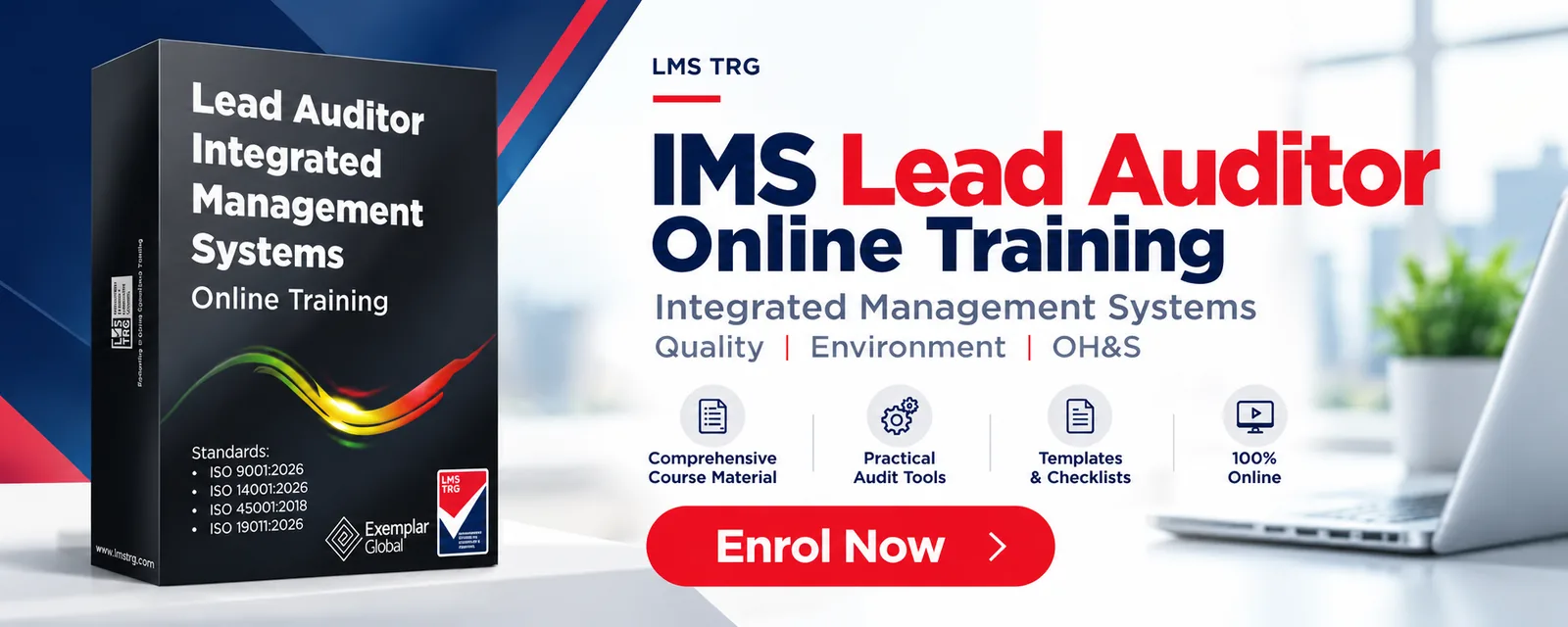
An IMS Lead Auditor Course covering ISO 9001, ISO 14001, and ISO 45001 can provide a structured pathway for professionals interested in auditing quality, environmental, and occupational health and safety management systems.
Explore the IMS Lead Auditor Course
How to Become an ISO Lead Auditor: Step-by-Step
There is no single universal licensing pathway for ISO Lead Auditors. Requirements depend on the standard, industry, country, certification scheme, and type of auditing work.
The following steps provide a practical route into the profession.
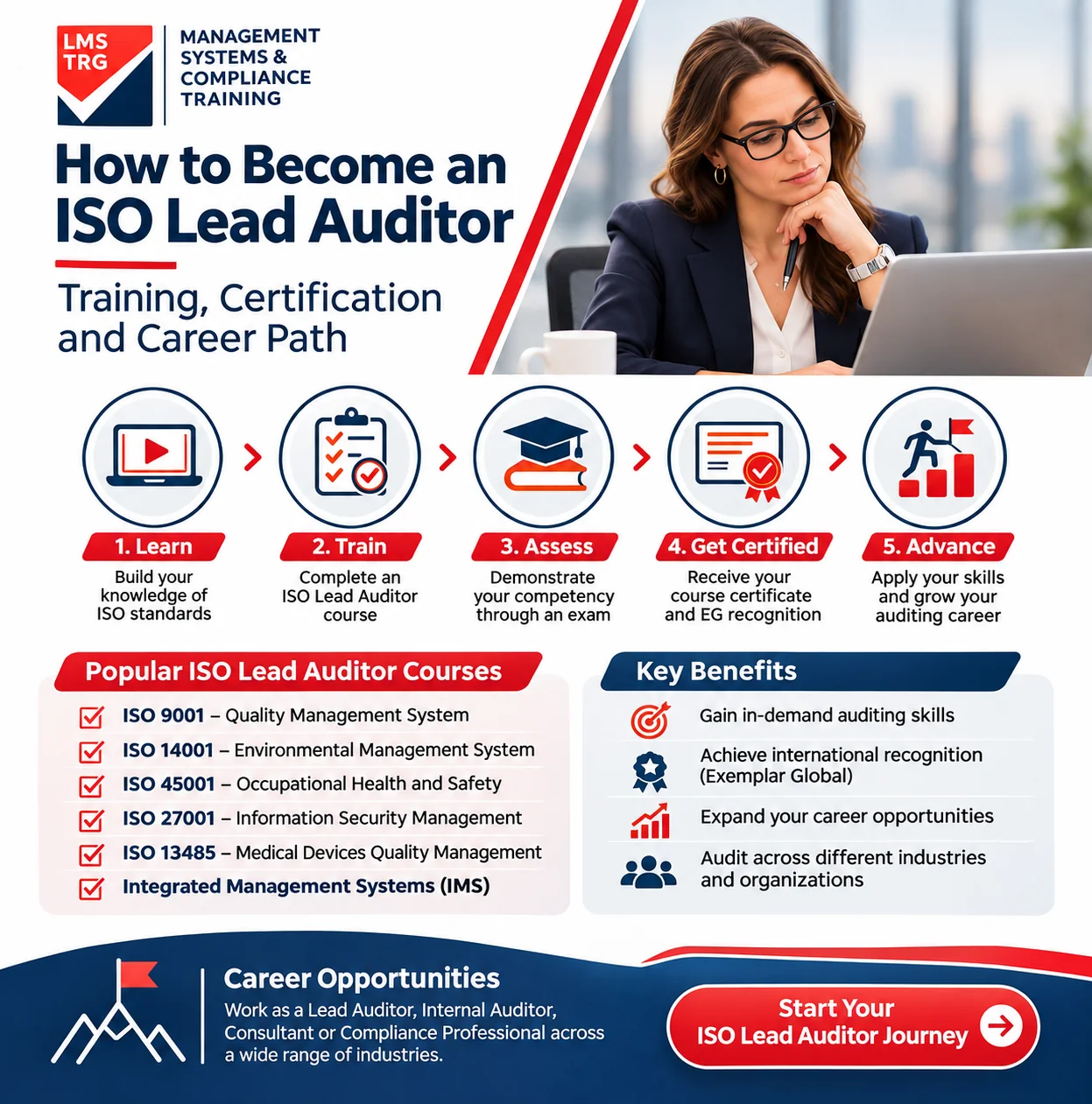
Step 1: Develop Your Understanding of ISO Management Systems
Before conducting audits, you need to understand how management systems operate and how ISO requirements apply to real organizations.
This includes understanding:
-
Organizational context and interested parties.
-
Leadership and management responsibilities.
-
Risk-based thinking and planning.
-
Operational controls and processes.
-
Performance monitoring and evaluation.
-
Internal audits and management reviews.
-
Nonconformities, corrective actions, and continual improvement.
Previous experience in quality assurance, environmental management, occupational health and safety, compliance, or operational management can be valuable.
A university degree is not universally required to attend ISO Lead Auditor training. Relevant educational and professional experience requirements may apply when seeking professional auditor certification or employment with a certification body.
Step 2: Complete an ISO Lead Auditor Training Course
Completing a structured ISO Lead Auditor training course is one of the most important steps toward developing professional auditing competence.
A comprehensive course should cover both the requirements of the relevant management system standard and the principles and practices of auditing.
Key training topics typically include:
-
Understanding and interpreting ISO requirements.
-
Audit principles and professional auditor behavior.
-
Audit planning and preparation.
-
Audit evidence and sampling.
-
Conducting interviews and audit activities.
-
Identifying and documenting nonconformities.
-
Audit reporting and communication.
-
Leading audit teams.
-
Managing audit challenges and disagreements.
-
Audit conclusions and follow-up.
Auditor training commonly incorporates the guidance provided in ISO 19011, Guidelines for Auditing Management Systems.
When selecting a course, consider whether the training includes practical exercises, case studies, assessments, and recognized competency units.
Online ISO Lead Auditor training can be particularly useful for working professionals who need to balance professional development with existing commitments.
Learn how to become an ISO Lead Auditor, including qualifications, training, certification, and career opportunities. Explore online courses with LMS TRG.
Step 3: Understand ISO Lead Auditor Certification Requirements
One common source of confusion is the difference between completing an ISO Lead Auditor course and obtaining professional auditor certification.
These are related but separate achievements.
Lead Auditor Training Certificate
A training certificate demonstrates that you have successfully completed a course and met its assessment requirements.
Depending on the training provider and course recognition, it may also demonstrate completion of specific auditor competency units.
Professional Auditor Certification
Professional auditor certification is a separate process offered by auditor certification bodies.
Organizations such as Exemplar Global and CQI IRCA provide auditor certification or registration pathways under their respective schemes.
Depending on the scheme and certification grade, applicants may need to demonstrate:
-
Successful completion of recognized auditor training.
-
Relevant education or professional experience.
-
Practical audit experience.
-
Experience leading audits.
-
Continuing professional development.
-
Ongoing compliance with certification requirements.
The requirements are not identical across certification bodies.
Therefore, before selecting a certification pathway, review the current eligibility requirements of your preferred professional certification body.
Step 4: Gain Practical Auditing Experience
Training provides the technical knowledge and skills needed to begin your auditing journey, but practical experience is essential for developing competence.
If you are new to auditing, you can begin by participating in internal audits within your organization.
As you gain experience, you may progress to:
-
Participating in audits as an audit team member.
-
Conducting internal management system audits.
-
Participating in supplier or second-party audits.
-
Taking responsibility for planning and coordinating audits.
-
Leading audit teams under appropriate supervision.
-
Pursuing external auditing opportunities when you meet the applicable competence requirements.
Maintaining records of your audit experience is particularly important if you intend to apply for professional auditor certification.
Your records may need to demonstrate the type of audits conducted, audit duration, your responsibilities, and the management system standards involved.
Step 5: Build Your Professional Career
Once you have completed your training and developed practical experience, you can explore different career opportunities.
ISO Lead Auditor competencies can support professional development in roles such as:
-
Internal Lead Auditor.
-
Quality Assurance Manager.
-
QHSE or HSEQ Manager.
-
Environmental Compliance Manager.
-
Occupational Health and Safety Auditor.
-
Supplier Quality Auditor.
-
Management Systems Consultant.
-
External Management Systems Auditor.
-
Certification Body Auditor, subject to additional qualification and competence requirements.
These opportunities exist across manufacturing, construction, engineering, healthcare, logistics, energy, technology, professional services, and many other industries.
Your career progression will depend on your technical knowledge, industry experience, auditing competence, and professional qualifications.
Internal Auditor vs Lead Auditor: What Is the Difference?
Although both roles involve evaluating management systems, their responsibilities and expected competencies can differ.
| Internal Auditor | Lead Auditor |
|---|---|
| Conducts audits within an established audit program | May plan, coordinate, and lead audit activities |
| Focuses on assigned audit areas and processes | Oversees the audit process and audit team |
| Collects and evaluates audit evidence | Manages audit activities and evaluates overall audit conclusions |
| Reports audit findings | Takes responsibility for audit reporting and team coordination |
| May work as part of an audit team | Requires additional competence to manage and lead audit teams |
An Internal Auditor can progress toward a Lead Auditor role through further training and practical experience.
For professionals already conducting internal audits, completing Lead Auditor training can be a logical next step in their career development.
Is ISO Lead Auditor Training Suitable for Beginners?
Yes. Some ISO Lead Auditor courses are designed to accommodate participants without previous auditing experience.
For example, the LMS TRG Integrated Management Systems Lead Auditor Course does not require previous auditing or management systems experience for enrollment.
This makes it accessible to professionals who want to begin developing their auditing knowledge, as well as experienced auditors seeking to broaden their qualifications.
While previous experience may not be necessary to enroll, it remains important to distinguish training eligibility from the experience requirements associated with professional auditor certification and certain auditing positions.
Why IMS Lead Auditor Skills Are Valuable
Organizations increasingly need professionals who understand how different management system requirements interact.
Quality, environmental, and occupational health and safety issues are often closely connected.
For example, a manufacturing process may involve product quality controls, environmental impacts, and workplace safety hazards.
An auditor with knowledge across all three disciplines can evaluate how these processes are managed within an integrated system.
IMS Lead Auditor training can help professionals:
-
Develop auditing knowledge across multiple ISO standards.
-
Understand the relationships between different management systems.
-
Plan and conduct integrated audits more effectively.
-
Identify opportunities to reduce duplicated audit activities.
-
Strengthen their understanding of organizational risks and controls.
-
Expand their professional development options across different industries.
For QHSE and HSEQ professionals, integrated auditing knowledge can be particularly useful because their responsibilities frequently cover more than one management system.
Choosing the Right Online ISO Lead Auditor Course
Not all ISO Lead Auditor training programs are the same.
Before enrolling, consider the following questions.
1. Does the course cover the relevant ISO standards?
Confirm that the course includes the editions of the standards applicable to your intended work.
2. Is the training provider recognized?
Review the provider's recognition status and the competency units associated with the course.
3. Does the course include practical auditing activities?
Auditing requires more than memorizing standard requirements. Case studies, audit exercises, and practical examples can help you apply what you learn.
4. Is the course flexible?
Online, self-paced learning can be particularly valuable for professionals managing work, travel, and other commitments.
5. What qualification or certificate will you receive?
Understand whether the course provides a training completion certificate, recognized competency units, or another form of qualification.
6. Will the course support your long-term career goals?
Consider whether you want to specialize in one management system or develop broader competencies across multiple standards.
Develop Your Lead Auditor Skills with LMS TRG
If you are looking for a flexible pathway to develop professional auditing skills across multiple management systems, the LMS TRG Integrated Management Systems (IMS) Lead Auditor Course provides comprehensive training covering:
-
ISO 9001 – Quality Management Systems.
-
ISO 14001 – Environmental Management Systems.
-
ISO 45001 – Occupational Health and Safety Management Systems.
-
ISO 19011 – Guidelines for Auditing Management Systems.
The course is designed for professionals seeking to develop the knowledge and skills needed to plan, conduct, report, and lead management system audits.
What Makes the LMS TRG IMS Lead Auditor Course Different?
100% Online and Self-Paced
Study from anywhere in the world and progress through the training according to your own schedule.
Exemplar Global Recognized Training
LMS TRG is an Exemplar Global recognized training provider, offering training covering recognized management system auditing competency units.
Three Management Systems in One Course
Develop knowledge of quality, environmental, and occupational health and safety management systems through one integrated training program.
Practical Auditing Resources
Access audit checklists, sample audit plans, audit report templates, case studies, and supporting training materials.
Suitable for Different Experience Levels
The course is suitable for beginners, internal auditors, consultants, QHSE professionals, and experienced management systems practitioners.
Flexible Learning Duration
The program is equivalent to approximately 56 hours of training, allowing participants to complete the modules at their own pace.
Take the Next Step in Your Auditing Career
Whether you are starting your auditing journey or looking to expand your existing qualifications, developing Lead Auditor competencies can create new opportunities for professional growth.
With the right training, practical experience, and continued professional development, you can build a career in management systems auditing across industries worldwide.
Ready to develop your ISO Lead Auditor skills?
Explore the LMS TRG IMS Lead Auditor Course and Enroll Online
Frequently Asked Questions About Becoming an ISO Lead Auditor
1. How do I become a certified ISO Lead Auditor?
A typical pathway involves completing relevant ISO Lead Auditor training, gaining practical audit experience, and applying for professional auditor certification through a recognized certification body. Specific requirements depend on the certification scheme and auditor grade.
2. Do I need a degree to become an ISO Lead Auditor?
A university degree is not universally required to enroll in ISO Lead Auditor training. Professional certification bodies and employers may have specific education, experience, or competence requirements.
3. Can I become an ISO Lead Auditor without experience?
You can begin Lead Auditor training without previous auditing experience if the course permits it. Becoming competent to independently lead audits, or obtaining professional auditor certification, generally requires additional practical experience.
4. How long does ISO Lead Auditor training take?
Course durations vary by provider, delivery method, and the number of standards covered. The LMS TRG IMS Lead Auditor Course is equivalent to approximately 56 hours of self-paced training.
5. Can I complete ISO Lead Auditor training online?
Yes. Many training providers offer online ISO Lead Auditor courses. LMS TRG offers 100% online, self-paced training that can be accessed internationally.
6. Is ISO Lead Auditor certification internationally recognized?
ISO management system standards are internationally used, and recognized auditor training can support career opportunities across countries. Acceptance of training certificates and professional auditor credentials depends on employers, certification bodies, and applicable certification schemes.
7. What is the difference between ISO 9001 Lead Auditor and IMS Lead Auditor training?
ISO 9001 Lead Auditor training focuses on auditing Quality Management Systems. IMS Lead Auditor training covers multiple management systems, commonly ISO 9001, ISO 14001, and ISO 45001, together with the skills needed to conduct integrated audits.
8. Can an ISO Lead Auditor work for a certification body?
Yes, provided they meet the certification body's applicable competence, experience, and qualification requirements. Completing Lead Auditor training alone does not guarantee eligibility for certification-body auditor positions.
About LMS TRG
LMS TRG is an Australian-based Auditor Training Provider and Exemplar Global Recognised Training Provider, delivering high-quality, practical and industry-focused ISO training across Australia and internationally.
We provide professional auditor training to individuals, businesses and large organisations. We also have established partnerships with leading certification bodies, delivering auditor training on their behalf as part of their training services.
Our 100% online, self-paced courses cover ISO 9001, ISO 14001, ISO 45001, ISO 27001, ISO 13485 and Integrated Management Systems (IMS), offering Foundation, Internal Auditor and Lead Auditor Training to suit different levels of experience and professional development needs.
Our training helps professionals develop auditing skills, achieve recognised competencies and advance their careers, while supporting organisations in building capable, confident and competent audit teams.
Join The Community
Our email content is full of value, void of hype, tailored to your interests whenever possible, never pushy, and always free.